
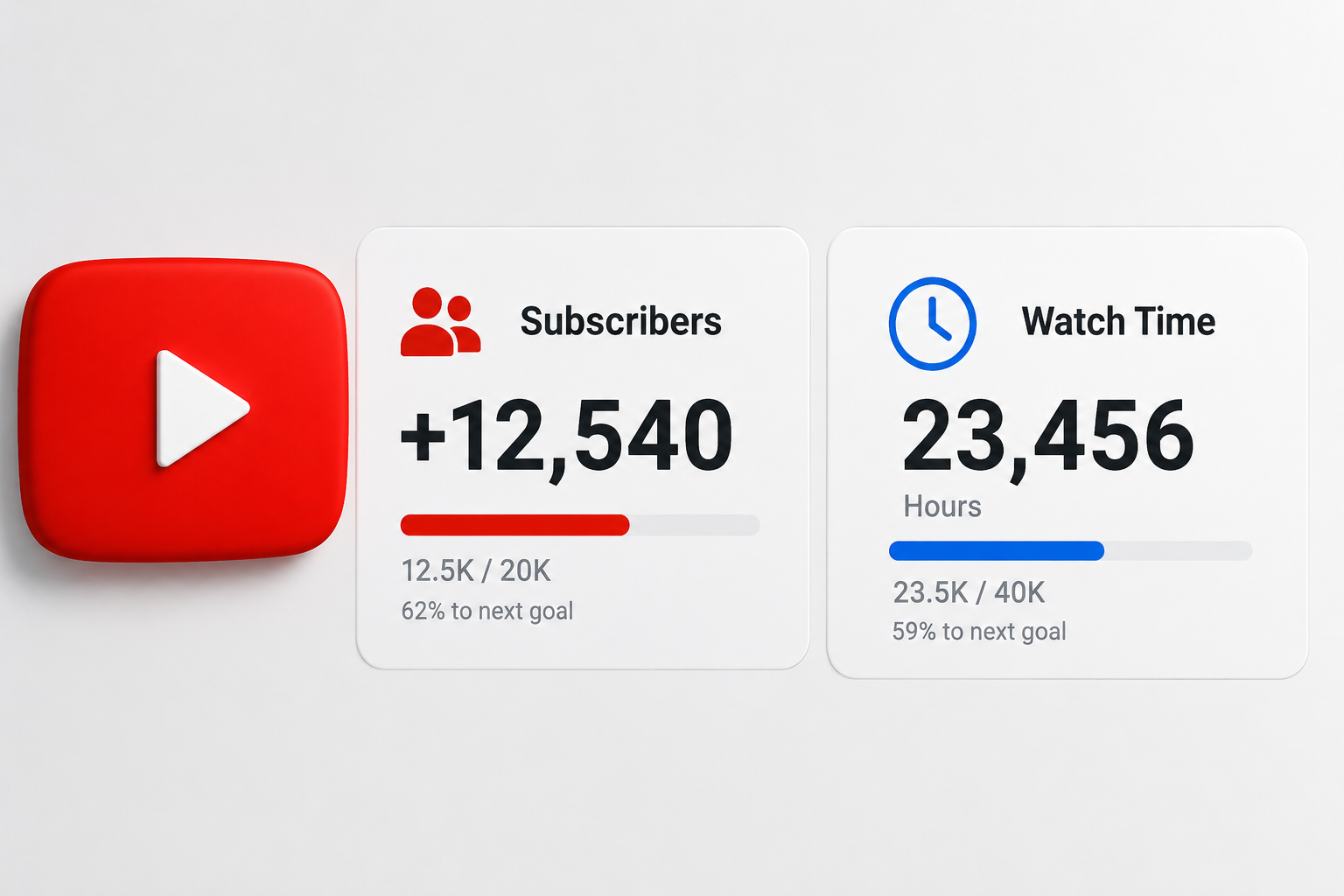
YouTube is the slowest social platform to grow on — and the most valuable. Videos rank in Google and YouTube search for years, subscribers actually see your uploads, and monetization pays real money. The trade-off is patience: YouTube rewards depth and consistency, not viral luck. Here's exactly how the system works, the numbers that decide your growth, and the tactics that get a channel moving in 2026.
The three numbers that matter
- Watch time — total minutes watched. This is YouTube's main currency: more watch time = more recommendations.
- Click-through rate (CTR) — how often people click your thumbnail when shown. Below ~3% means your packaging is failing the video.
- Subscribers — they boost early views on every upload and are the trust signal new visitors check first. Channels with a credible subscriber base convert far more visitors — many creators build that base with real YouTube subscribers and watch time while their content library grows.
How the YouTube algorithm decides what to recommend
YouTube's goal is to keep people on YouTube. So it promotes videos that earn clicks (CTR) and then hold attention (watch time and retention). A great thumbnail with a weak video gets suppressed after the first wave; a weak thumbnail on a great video never gets the chance. You need both: packaging that earns the click and content that delivers on it. Everything else — tags, descriptions, hashtags — is minor next to CTR × retention.
Monetization requirements (2026)
To join the YouTube Partner Program you need 1,000 subscribers plus either 4,000 hours of public watch time in 12 months or 10 million Shorts views in 90 days. For most channels, watch time is the wall — long-form videos that hold attention are the fastest path through it. Shorts can get you the subscribers quickly, but long-form is what builds the watch-time hours that actually pay.
7 tactics that grow channels
- Pick one niche and stay in it. The algorithm needs to learn who to recommend you to.
- Design the thumbnail before filming. If you can't make it clickable, don't make the video.
- Front-load the first 30 seconds. Deliver on the title immediately — retention graphs die in the intro.
- Use Shorts as a funnel. Shorts find new viewers; long-form converts them into subscribers and watch time.
- Title for search. "How to…" videos keep collecting views for years.
- End with one next video, not five options — chained sessions multiply watch time.
- Upload on a schedule. Weekly beats daily-then-quitting. Consistency compounds, as shown in the effect of social media on growth.
Shorts vs. long-form: which to focus on
Use both, with a clear job for each. Shorts are your discovery engine — they reach new viewers fast and grow your subscriber count toward the 1,000 threshold. Long-form is your value and revenue engine — it builds the 4,000 watch-time hours, ranks in search for years, and earns far more per view. The winning play in 2026 is Shorts to get discovered, long-form to convert and monetize, with each Short pointing viewers to a related long-form video.
Mistakes that stall YouTube channels
- Weak thumbnails and titles — if nobody clicks, nothing else matters.
- Jumping between niches — the algorithm never learns who to show you to.
- Long, slow intros — retention dies in the first 30 seconds.
- Quitting too early — most channels break out after months, not weeks.
- Ignoring CTR data — your analytics tell you exactly which packaging works; most creators never look.
Frequently asked questions
How do I grow a YouTube channel from zero?
Pick one niche, package every video with a clickable thumbnail and title, hook viewers in the first 30 seconds, use Shorts to get discovered and long-form to build watch time, and upload on a consistent schedule.
What is watch time and why does it matter?
Watch time is the total minutes people spend watching your videos. It's YouTube's main ranking signal — more watch time earns more recommendations — and 4,000 public hours is a monetization requirement.
How many subscribers do I need to make money on YouTube?
1,000 subscribers plus either 4,000 hours of watch time in 12 months or 10 million Shorts views in 90 days to join the Partner Program.
Do Shorts or long-form videos grow a channel faster?
Shorts grow subscribers and discovery fastest; long-form builds watch time and revenue. Use Shorts to get found and long-form to convert and monetize — together they grow a channel fastest.
Want to shortcut the cold-start phase? Create a free Widerz account for YouTube subscribers, views and watch time with instant delivery — and check out how an SMM panel works if you're new to growth services.